
Liquid Natural Gas in New Zealand
The New Zealand government (MBIEs “Government Investment in Dry Year Risk Cover: Consideration of an LNG Import Facility” 10 Feb 2026) sets out the case for importing liquified natural gas (LNG). There are a variety of potential technical solutions, and they all involve the use of a marine vessel containing large quantities of LNG. There has been little or no discussion on the safety implications of transporting, storing and regasifying large quantities of LNG.
While the LNG industry’s safety record remains strong overall, with few catastrophic events, safety analyses emphasize the potential scale of the highest consequence events even if there is a low probability they may occur. If a release occurs, the heavier-than-air vapor cloud (initially) can travel significant distances remaining at sea/ground level due to its low temperature. but with a vertical extent sufficient to overcome typical physical barriers such as sea walls.
On account of the low temperature at which LNG is stored (-162°C), when it comes into direct contact with seawater, it near-instantaneously vapourises generating shock waves which could cause localized equipment damage (such as to a vessel’s hull) potentially escalating any loss of containment incident. In this case the main mitigation effort is to ensure that any leaks are minimised or picked up by nearby drainage systems dedicated to LNG.
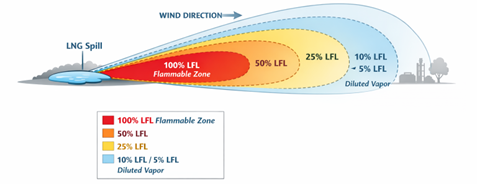
These risks are mitigated by engineered safeguards. Separation distances between the vessel and onshore people and facilities illustrated by map contours relating to blast overpressure, heat radiation and gas dispersion. Typically shown by LFL (lower flammability limits) as in the fig below:
A LNG marine vessel incorporates a large quantity of LNG and the obvious precaution is to prevent damage to the vessel which could result in a release. There are technological solutions to preventing loss of containment such as secondary containment of storage, double hull configuration, use of appropriate low temperature materials and Boil Off Gas management. Another area of safety to be considered are safety procedures to be used during the approach of the vessel to its mooring area and the mooring itself.
A major decision in terms of safety is related to the location of the gasification unit, that is, whether it is on the vessel or onshore. This will be a difficult assessment in terms of safety as the pros and cons for onshore/offshore gasification are varied and require a thorough investigation. No storage has been considered onshore as yet suggesting the gas system will be packed to store any incoming gas. Storing gas in pipeline systems (known as “pipeline packing”) should be compared to the provision of storage systems local to the mooring point.
Another area for scrutiny will be the transfer of LNG / gas to shore. The choice between transferring LNG liquid or as a vaporised gas will require different technologies such as loading arms, flexible hoses or use of a single buoy mooring. All require rapid unlocking systems to allow the LNG vessel to disengage and move away in the event of an emergency. Incident investigation also reveals most loss of containment issues concern the load arms / connection between land and vessel.
In order to achieve a accelerated schedule it is prudent to ensure that all safety requirements and permitting will be looked at early in the conceptual stage of the project. Although the FSRU is likely to have a Risk Assessment it may be difficult to update and the whole system would require a completely new study as an input to the demonstration of SFAIRP.
In summary the proposed design not only needs to be financially assessed but also subject to rigorous safety reviews and assessment. Whilst the addition of leak detection, fire and gas detection maybe considered minor in terms of costs and schedule, any change to the design following the safety assessments can be costly due to the late stage of the process that such changes would be identified. Therefore, for a short, schedule dependent project early detailed safety assessment is required to avoid late changes.
For further information contact our Process Safety Specialist Roy Singer.
